Why Does Mindfulness Feel Impossible For Neurodivergent Brains?

Today in the West, or at least in my little corner of Southern Ontario, mindfulness seems largely synonymous with stillness and seems to be consistently linked to meditation. The word recalls images of people in quiet rooms, legs crossed, thoughts gone... peace achieved.
For a lot of neurodivergent folks, including myself, this ideal feels difficult, if not straight unrealistic or absurd. We tell ourselves things like “that sounds amazing, I just know I could never do it,” or we try it once and emerge from it feeling greater anxiety or dysregulation than before, with an added dose of shame from not being able to immediately succeed.
A Neuro-Affirming Approach
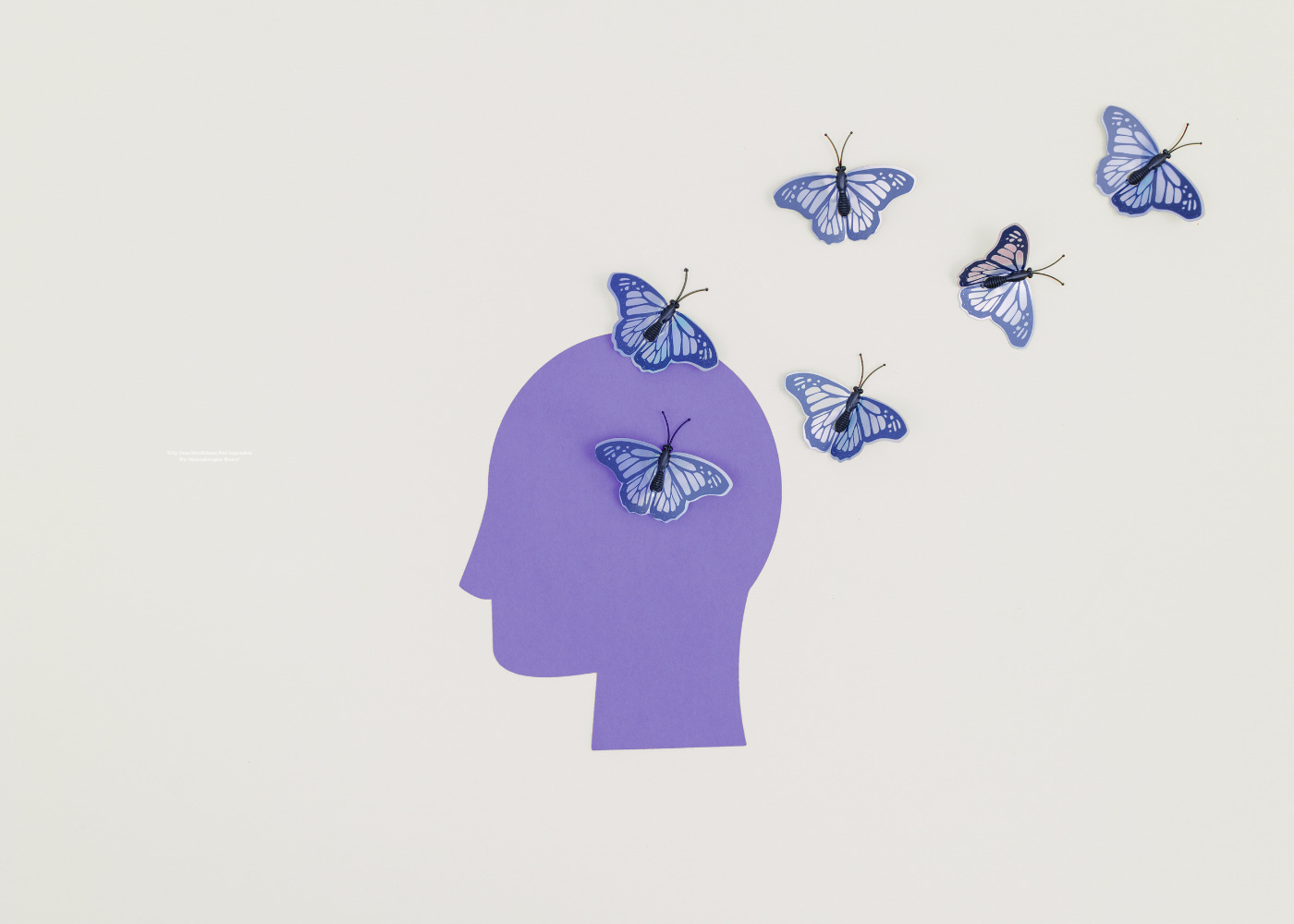
I want to propose an alternate, broader idea of mindfulness that has worked for me. I focus on 2 things: being present in the moment, and having a point of focus. As long as I can do those two things, I let myself be flexible with the rest. I don’t try to eliminate thought altogether, but I notice where my mind starts to wander (or full-on run away), pay attention to those thoughts, and then gently bring them back to centre.
That “coming back” is a fundamental part of my process, especially without judging ourselves.
What this looks like can vary: focusing on your breath, tossing a ball in the air and tracking it as it goes up and down, listening closely to a song, watching a flame burn and flicker, or even cooking while staying fully present and noticing all the textures and smells as you go.
For ADHD brains in particular, focus often comes more easily when there’s movement or sensory input involved. So you could go for a walk outside and sync your steps to something (your breathing, the sound of a soccer ball being kicked, the wind). You might find that movement to be more regulating than forcing stillness.
Stillness isn’t a requirement. Rocking is allowed. Pacing is allowed. Stimming is allowed. Sound is allowed (humming, whispering, blurting). As long as your attention is anchored in the moment, it counts. Hyperfocus can also sometimes function as a form of mindfulness, as can spending time on a special interest.
Let’s Not Ignore The Origins
Practices of mindfulness and meditation have deep roots in Eastern traditions: mindfulness from Buddhism, where it ties to deeper and broader philosophical and spiritual frameworks, and meditation from ancient Hindu scriptures (though it was likely practiced even thousands of years before).
When Buddhist groups arrived on the East Coast of Canada in the later part of the 20th century, they were aware that their traditional practice would need to be translated and adapted in order to be shared with and adopted by North Americans. And when mindfulness entered Western psychology in the 1970s (most prolifically through Jon Kabat-Zinn’s Mindfulness-Based Stress Reduction (MBSR) program) it was adopted into a more secular, clinical context.
Research shows mindfulness practices can reduce stress, anxiety, and depressive symptoms, and may be particularly helpful for ADHD and autistic individuals who generally experience a heightened baseline level of nervous system arousal. Even brief (but consistent) practice can have significant benefits for the nervous system.
But for that to happen, the practice has to be accessible. People who can benefit from it need to believe that it can work for them, and then actually feel that benefit in themselves.
I believe that there is room for adjustment within the adapted and appropriated mindfulness practices in the contemporary West. Expanding what we think of as mindfulness shouldn’t mean discarding its origins, but finding a way to let the practice meet you where you are.
You don’t have to sit still.
You don’t have to be silent.
You don’t have to completely empty your mind.
Mindfulness, at its core, shouldn’t be about practicing one specific “right” way. It’s about centreing and re-centring, focusing, breathing, and being present. It’s about learning the way that works for you to come back to yourself in the present moment with patience and without judgment.