Therapy is Political
A call to action for registrants of the CRPO

Therapy is political. To be a therapist is to be an activist.
If this statement feels uncomfortable, I’m writing this for you. If this is something you already feel in your bones, I invite you to continue reading as an exercise of marination in the therapeutic code of ethics, your role in society (therapist or not), and what it all means.
Each therapist registered with the College of Registered Psychotherapists of Ontario (CRPO), at some point or another, throughout hundreds of hours of schooling, training, practice, client hours, reflection, and research, must swear an oath in front of an officiant.
This job is not just permission to do our best to help people and to give quirky advice; it is a sworn duty to society. This is some serious stuff we’ve signed up for.
When I say “to be a therapist is to be an activist,” I’m not just expressing personal sentiment. This is something concrete and provable. Let’s take a hard look at the 7 pillars of the CRPO’s Code of Ethics and examine the political and social responsibilities therapists take on and swear by as professionals.
Pillar #1
Autonomy & Dignity of All Persons: To respect the privacy, rights and diversity of all persons; to reject all forms of harassment and abuse; and to maintain appropriate therapeutic boundaries at all times.
In the therapy room, this first pillar looks like respecting the autonomy and dignity of our clients: respecting consent for treatment and interventions; doing our best to understand and continue to educate ourselves in our own time regarding their culture, lived experience, values and world views. It looks like abiding by confidentiality agreements. It looks like sitting with them, truly listening, and being present in moments in which they share how they’ve been harassed and abused by others throughout their lives. It also looks like leaving space for their independence outside of the therapy space.
And outside of the therapy room? Some would say our job is done. We’ve clocked out. Our only problems are our own. This is true in a sense. We all need healthy emotional boundaries and work/life balance.
What I want to confront here is the dissonance between supporting a client’s right to privacy and diversity, and rejecting all forms of harassment in the therapy space, while existing in a reality constructed of oppressive systems that can only begin to be dismantled with help from the masses.
When I say “the masses,” I mean your average cisgender, hetero sexual, white allies. The ones making an average annual income. The ones who have the privilege of clocking out and ignoring (or being completely unaware of) decades of oppression, harassment, abuse, and violence.
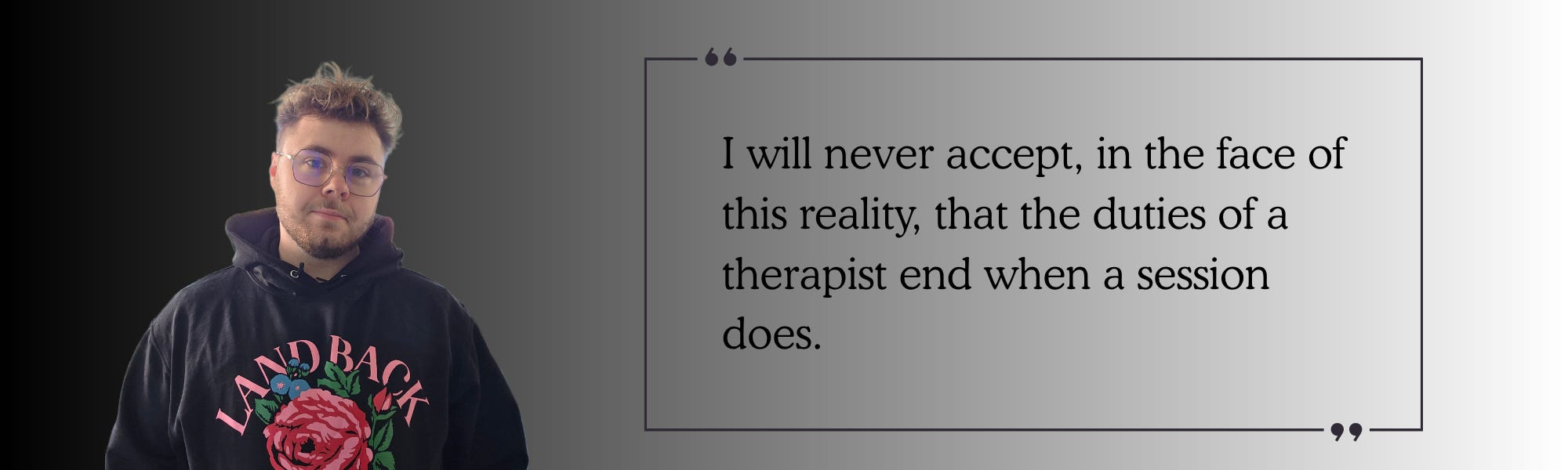
I will never accept, in the face of this reality, that the duties of a therapist end when a session does. To genuinely uphold the dignity and autonomy of all persons requires more than sitting and listening for 55 minutes biweekly. Truly upholding pillar #1 of our ethical code requires an active engagement and confrontation with the politics, policies, and structures that underpin our society.
What we can do to better uphold pillar #1:
Educate your neighbours and friends. Inform yourself and those around you on why human rights matter, whose rights are being violated, how, and by whom. Combat myths or stereotypes with facts.
Call your representatives and local elected officials. Every call or email makes a difference.
Show up to rallies and protests near you. Stay safe and know your limits. This one is not for everybody.
Speak out digitally. Sign petitions you believe in, and speak out on social media.
Support Human Rights with your dollar. Consider the track record of the companies and stores you shop from. Donate to trusted organizations working towards these values.
Importantly: stay connected while staying grounded.
Pillar # 2
Excellence in Professional Practice: To work in the best interests of clients; to work within my skills and competencies; maintain awareness of best practices; and to pursue professional and personal growth throughout my career.
This second pillar of the ethical code explicitly requires therapists to pursue growth both professionally and personally. It emphasizes the importance of bringing this ethical code outside of the therapy space, and the necessity of personal and professional growth aligning with the best interests of the client.
In the therapy space this means the maintenance of positive regard for the client, a consistent consideration of the client’s values and goals, and the continued pursuit of education, awareness, and certifications that will benefit both the clients and the practice.
In 2026, psychotherapists in Ontario will work with clients of the Global Majority, otherwise known as People of Colour. We will also work with members of other marginalized populations, including people facing physical or mental disabilities, health issues, socio-economic struggles, immigration issues, ageism or age-related neglect, gender and sexuality concerns, as well as harassment or stress related to ethnicity, culture, and religious beliefs.
Members of each of these groups are currently negatively affected by ongoing events, politics, municipal, provincial, and federal legislation. This is not an opinion, it is the reality. Another reality is that these conditions can be – and historically have been – affected by effective activism, mutual aid, community work, and political involvement by the masses. Organized activism and pushback work.
The conclusion is inevitable. We are bound as therapists to uphold this pillar of excellence in practice, to work in the best interests of our clients and to pursue excellence in both the personal and professional spheres. We know that the best interests of our clients are bound to these social, economic, and political realities. We know that we have some capacity (though what form this takes and how much dedication can realistically be given will of course vary from individual to individual and where they stand in their privilege and capabilities) to aid in bettering these situations. Active political involvement that works toward helping these communities and fighting for their rights is a fundamental and necessary requirement in upholding this ethical pillar.
Pillar # 3
Integrity: To openly inform clients about options, limitations on professional services, potential risks and benefits; to recognize and strive to challenge my own professional and personal biases; and to consult on ethical dilemmas.
Integrity: the quality of being honest, having strong moral principles, and upholding them with behaviour and action.
This pillar of the ethical code solidifies the role of a therapist as both professional and personal, while also requiring the therapist to actively reflect on their willingness (or lack thereof) and capability to act with integrity, and in congruence with the code of ethics. It highlights the importance of alignment between the therapist’s personal and professional beliefs and requires honesty regarding such beliefs.
Given this ethical obligation, there should be no reason for a therapist to be unaware of their stance on any issue that could affect their clients socially, politically, or otherwise. Being unaware would limit the therapist’s ability to offer professional services and would be in direct violation of this third code of ethics, which directly indicates that therapists should notify their clients of any ethical dilemmas or personal biases.
This pillar is a call to action. If the therapist is striving to challenge their personal biases, they will, by simple necessity, be forced to confront the injustices taking place against their clients in this world. And they must ask themselves, will I be complacent in the struggles my clients face? or will I live and work with integrity by advocating for my clients’ rights in my personal life, as I do in the therapy space?
Pillar #4
Justice: To strive to support justice and fairness in my professional and personal dealings, and stand against oppression and discrimination.
Justice. The fourth pillar of our code of ethics states explicitly what the third, integrity, implies. This is a demand of each therapist to strive for justice and fairness in both professional and personal dealings, and to stand against oppression and discrimination.
Perhaps, up until this point in the code, one could find some wiggle room. Some space for interpretation and evasion. With this fourth pillar, there is no more wiggle room. The responsibility is ours, and we have sworn to it.
I urge therapists reading this to reflect on the past few years of their personal and professional lives. I want to assume the best of my fellow therapists. I want to make the assumption that when your client – experiencing harassment, oppression, discrimination, or hardship – comes to you in need of support, that you sit with them, that you help them name their feelings, help to name the systems that have been harmful, and that you support them in moving through what are often painful and inhumane situations, with support and allyship. I have to assume because I don’t hear or see into these hundreds of thousands of sessions.
But what might that same client see outside the therapy room? Maybe they see their therapist laughing or staying silent while an acquaintance makes racist, misogynistic, homophobic, xenophobic, ableist (fill in the blank) jokes at brunch. They see the polls every few years, a reminder that over half the population will vote against their basic rights. They see a crowd of protesters on the street, but don’t see their able-bodied therapist standing alongside them. They see their therapist being silent during active genocides, sex crimes, mass shootings, and deportations, as dozens of dehumanizing and dangerous bills get passed.
We could call this, at best, complacent and disappointing. But here are some other words that come to mind: unjust, negligent, and disingenuous.
Pillar #5
Responsible Citizenship: To participate in my community as a responsible citizen, always mindful of my role as a trusted professional, and to consult on potential conflicts of interest and other personal-professional challenges.
Responsible Citizenship. Let’s shift for a moment to those of us who do understand and believe in the fundamental relationship between the personal and the professional in this profession, and who understand, to some degree or another, that working as a therapist is a political act that requires further political action. We want to stand up for the injustices faced by our clients and our neighbours. How do we put that into action?
This fifth pillar of the code gives us a starting point: participate in your community. Begin to consult with other community members on challenges, opportunities, and conflicts of interest. Start to build the world you want to live in. These are the first steps to becoming the activist you have signed up to become by deciding to work as a therapist.
Ways to participate in your community:
Volunteer. Volunteering is a great way to give back, get to know others in your community, and spend time with others.
Support local businesses. Skip your daily Starbucks run and buy from local businesses.
Start building connections with other people, supporting members of your community in small ways, and spending time in third spaces.
Participate in local events. These can be events at your local library, community center, town hall, HOA, or somewhere you visit often. This can help build friendships you might not otherwise have had access to, in a world where human connection feels harder and harder to hold on to.
Engage in Local Civic Activities. Attend a town hall meeting, join a board, or help with advocacy groups or fundraisers.
***Many cities and townships in Ontario have websites dedicated to helping community members stay connected and get involved. Use your preferred browser to search for something that suits your lifestyle (or speak to your local librarian!)
Pillar #6
Responsible Research: To conduct only basic and applied research that potentially benefits society, and to do so safely, ethically and with the informed consent of all participants.
Research isn’t neutral. The questions we ask, who we choose to study, who we exclude, who we cite, who we consider “credible,” who we label as disordered or deficient: these choices are political. They shape policy. They shape funding. They shape public opinion. They shape how our clients are treated in schools, hospitals, courts, borders, and workplaces.
Historically, research has revolutionized the world in astounding ways. It has also propagated and enabled harm. It has pathologized. It has justified colonization, racism, ableism, misogyny, homophobia and more. It has spoken about communities instead of with them.
To conduct research ethically as a therapist in Ontario means more than obtaining a signature on a consent form. It means ensuring that consent is truly informed. That participants understand the risks and benefits. That they are not coerced by power dynamics. That their data will not be weaponized against them.
It means asking questions like: Who benefits from this research? Who could be harmed? Who is missing from the table? Am I extracting knowledge, or am I building a relationship? Responsible research requires humility and collaboration. It requires community consultation. It requires acknowledging the history of harm done in the name of “science” and choosing to do better.
Therapy is political, and research is policy in the making. Therapists do not get to pretend that the data we produce or search for exists in a vacuum.
Pillar #7
Support for Colleagues: To respect colleagues, co-workers, students, and members of other disciplines; to supervise responsibly; to work collaboratively; and to inspire others to excellence.
This final pillar is not softer than the others, and it is not secondary. It is fundamental. No therapist exists in isolation: we are shaped by our supervisors, professors, mentors, peers, and interdisciplinary teams. We refer to each other, we consult, and we co-facilitate. We share space in clinics and online platforms.
Supporting colleagues means more than being polite at networking events. It means checking-in when harm happens. It means refusing to tolerate discriminatory practices within our own professions. It means offering mentorship without exploitation and paying our interns fairly. It means giving credit where it is due, or not competing for scarcity when we are supposed to be building collective care. If we are committed to justice for clients, we must also be committed to justice within our field.
Fundamental pillars of our professional community (supervision, hiring, referral patterns, who gets platformed at conferences and who is passed over) are deeply and inherently political.
To inspire excellence is not to demand perfection; it is to model integrity. To model accountability. To model growth. It is to say, “I was wrong,” and mean it. To stay teachable. To refuse complacency. Therapists cannot claim to stand against oppression in session while perpetuating it in staff meetings. If therapy is political, then collegial support is infrastructure. And infrastructure determines whether movements survive.

If this ethical code is to be interpreted concretely, if it is meant to be lived, if these ethics are not just theoretical considerations, then therapy must be political. These pillars are ways of being: daily, in small conversations; in purchasing decisions; in supervision rooms; in town halls; In how we respond when harm unfolds in front of us.
The Code of Ethics is not a document we reference when we are in trouble. It is a mirror. It asks us, again and again, who are you when no one is watching? Who are you when it is inconvenient? Who are you when justice costs you something?
To be a therapist, specifically a therapist who has sworn to uphold this code of ethics, is not just to sit with pain. It is to refuse to be passive in the systems that create it.
Thank you for this critical reminder and call in — we all have more we can do to advocate within and beyond sessions ❤️